
As a leading scientific partner in BlueAdapt, Bangor University contributes essential expertise on how climate change is transforming coastal environments — and what this means for public health.
This year, a team from Bangor travelled to China to participate in an international symposium hosted by Hohai University, bringing together researchers working on coastal resilience, water quality, and environmental change and public-health risks.
Connecting Expertise Across Disciplines and Continents
The visit offered Bangor the chance to present BlueAdapt’s work to groups that typically focus on sediments, estuary dynamics and coastal habitats rather than pathogens. This made the exchange especially valuable because it allowed both sides to connect their expertise and explore how climate change, coastal processes and virus behaviour interact in ways that matter to communities.
During the symposium, Bangor presented several interconnected elements of their contribution to BlueAdapt:
- A high-level overview of wastewater and human-health challenges in Europe, framing the public-health dimension of BlueAdapt.
- Laboratory results on how viruses respond to changing environmental conditions such as temperature, sunlight, and turbidity.
- Modelling improvements developed using these experimental results, demonstrating how laboratory insights enhance predictive water-quality tools.
- Applications of these improved models to real estuaries, showing how different coastal systems may respond to climate-driven stressors like warming waters, sea-level rise and altered river flows.
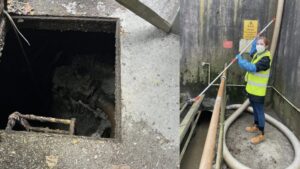
This storyline — from laboratory science to full estuary modelling — illustrates what makes Bangor’s role in BlueAdapt unique.
It is not often that viral-behaviour studies are integrated with hydrodynamic modelling, but this combination offers powerful insights. By linking how viruses respond to environmental conditions with how water circulates, BlueAdapt is better equipped to anticipate how pathogens circulate in changing coastal environments.
Strengthening BlueAdapt Through International Collaboration
The event provided an opportunity to strengthen collaboration with Hohai University. Joint lab experiments were postponed due to a super-typhoon, and the work will now be carried out in Wales next spring. These experiments will focus on how viruses attach to sediments and microplastics — and how natural biofilms form on these materials. Understanding these interactions is important because they influence how long viruses survive in the environment. The results will feed directly into the water-quality modelling used in BlueAdapt.
Beyond the planned experiments, the teams discussed new funding proposals, shared publications and options for long-term PhD exchanges. For example, students from Hohai are expected to join Bangor for extended research placements, which will deepen the partnership and strengthen BlueAdapt’s global reach.
Insights from UK estuary studies — examining how water and pollutants persist under future climate scenarios — provide additional context for BlueAdapt. A key measure, residence time, indicates how long water and contaminants remain before being flushed out, influencing potential health risks. While focused on the UK, the methods and findings are broadly applicable to European estuaries and will inform BlueAdapt case studies, particularly in Atlantic-facing regions.
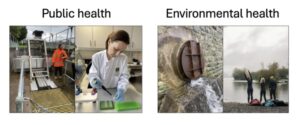
Applying Insights to Coastal Health
Bangor aims to apply its modelling to the Arno River case study in Italy and to explore how turbidity — cloudy or sediment-rich water — affects virus survival. Sediments can sometimes shield viruses from sunlight, influencing how long they remain infectious, a question central to BlueAdapt’s public-health focus.
These studies aim to strengthen understanding of coastal environments, where natural systems and human communities intersect, and vulnerabilities are greatest. The insights gained will help inform strategies to protect public health in changing climates.